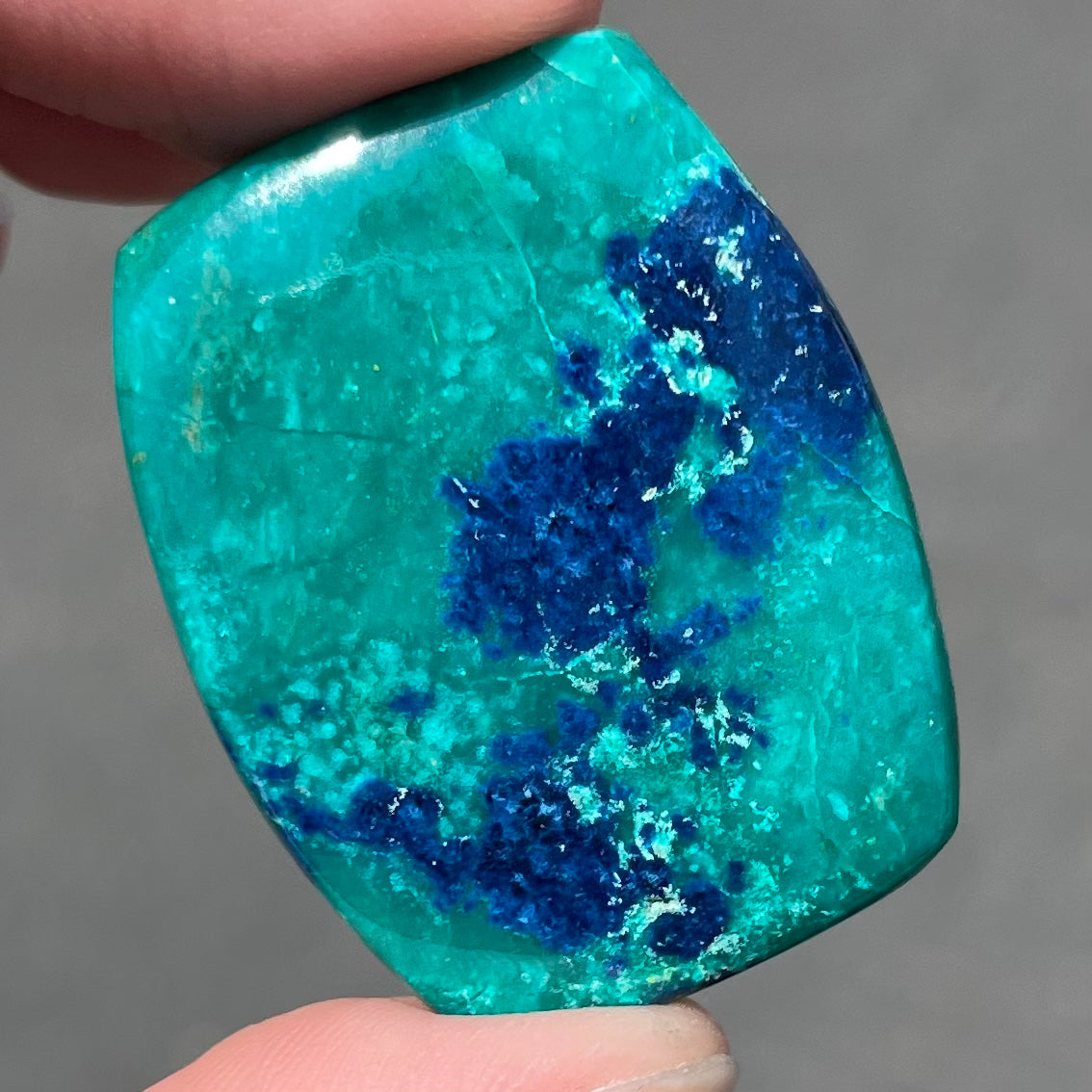
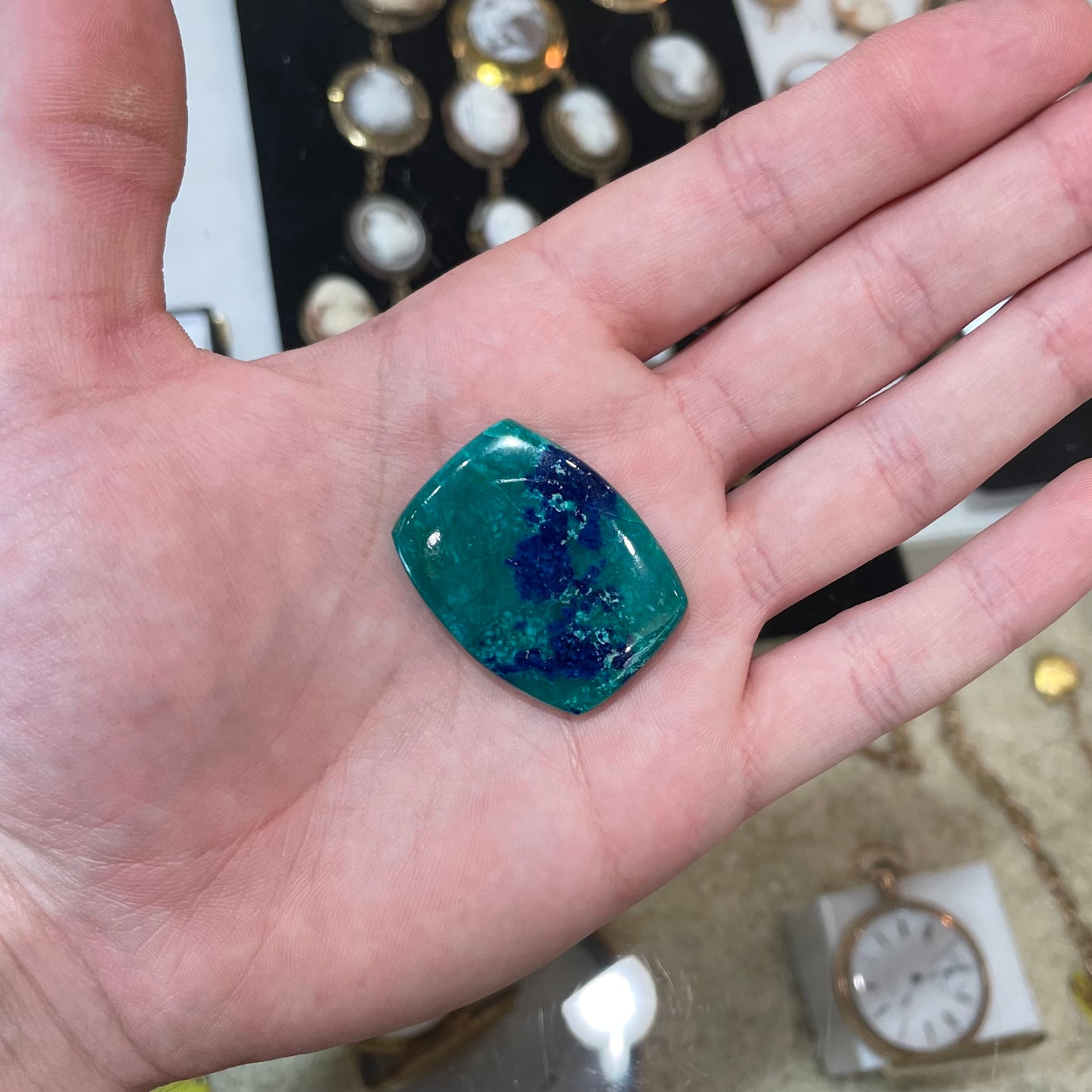
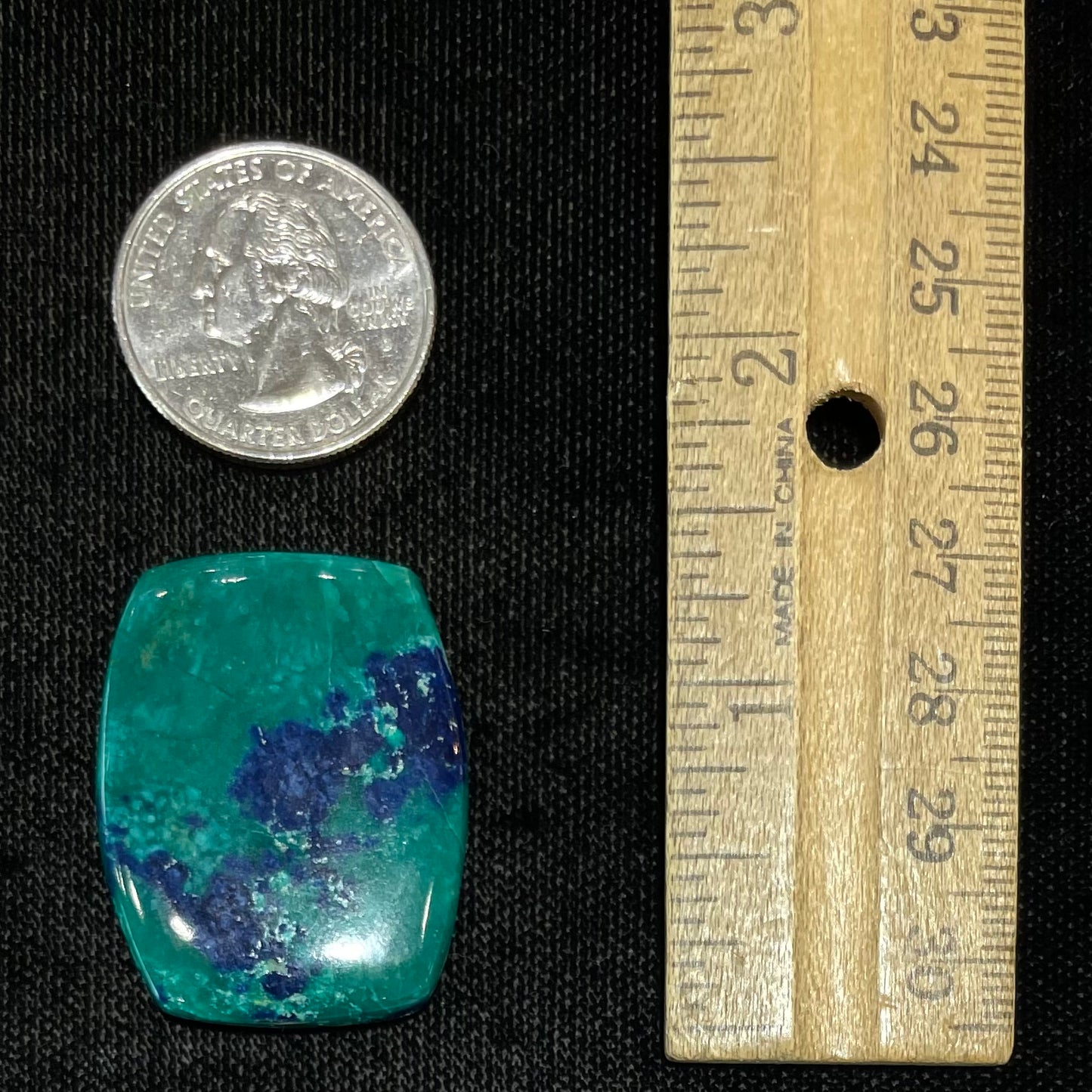
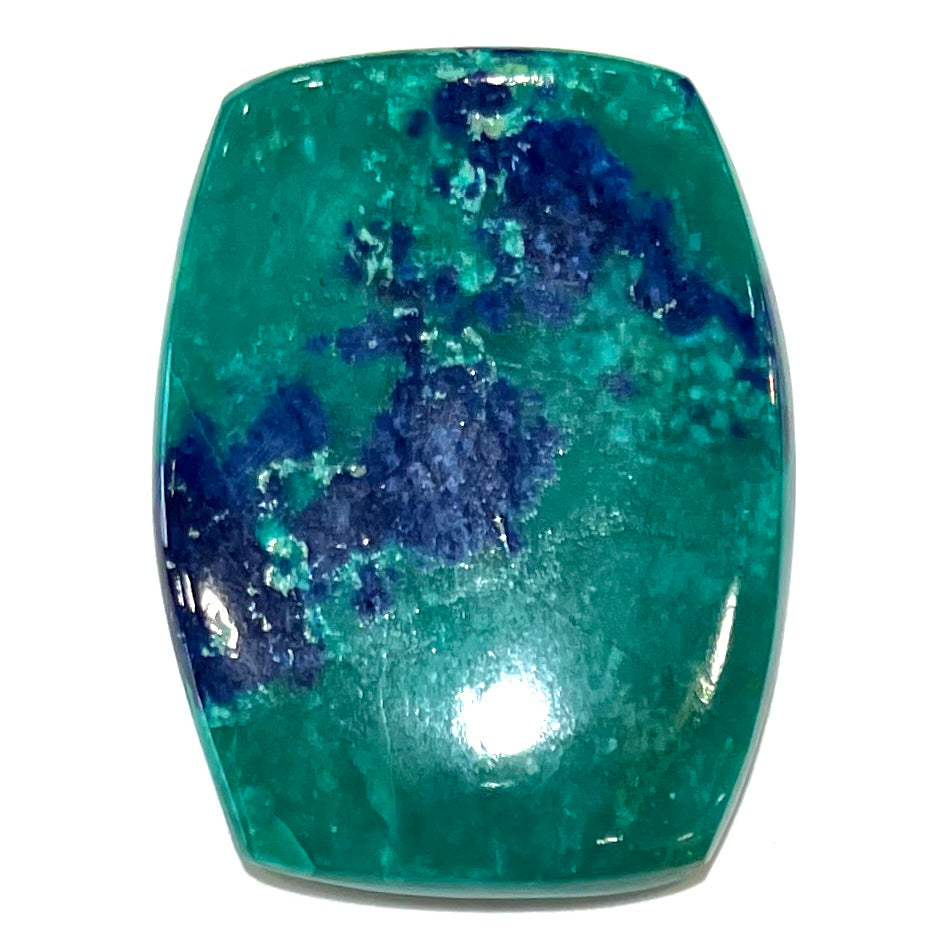
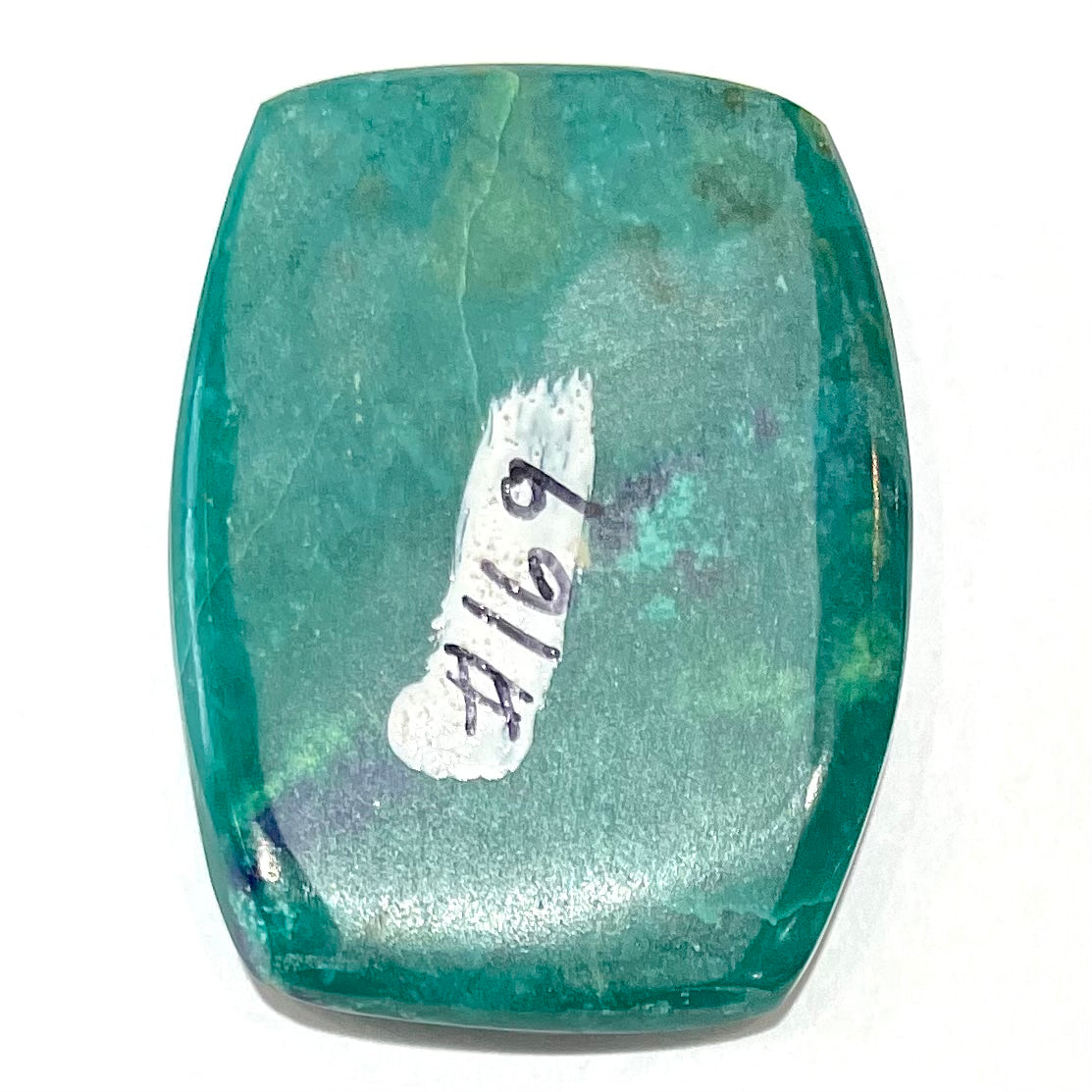
Chrysocolla with Azurite | #169
Couldn't load pickup availability
The Stone: Chrysocolla with Azurite
- natural
- unstabilized
The Weight: 64.88 carats
The Origin: Arizona
The Cut: Barrel Cabochon Cut
- stone measurements: 15.08mm x 27.23mm x 6.10mm
About Chrysocolla:
Chrysocolla, high grade material referred to as "gem silica," is a blue to green mineral colored by a high copper content. The mineral is often found in copper mines alongside turquoise, malachite, and azurite. Crystalized chrysocolla is rare but available on the market; material typically forms en masse. Chrysocolla's translucency helps differentiate it from opaque turquoise.
Chrysocolla is known to vary in durability. While pendants and earrings are always safe, only some pieces can be worn in rings every day. Material ranges from 2 to 7 on the Mohs hardness scale depending entirely on the amount of silica (or quartz) in the stone's makeup. Generally, dark navy blue pieces are softer, while cyan, green, and blue-green pieces are harder. It is not recommended to put chrysocolla in chemical silver cleaner unless you know for certain it is agatized (the result of having a high silica content).
Collapsible content
About the Stone
Turquoise, azurite, malachite and chrysocolla are all copper bearing minerals that form in the oxidized, upper zones of copper ore deposits. While variscite is not a copper-based mineral like the others, it is closely related to them in mineral families and frequently occurs in similar environments. Eilat stone is not a single mineral, but rather a naturally occurring, heterogeneous mixture of chrysocolla, malachite,
azurite, and turquoise.
Copper Siblings
Turquoise is a copper aluminum phosphate. It shares the same copper genesis as azurite, malachite and chrysocolla, which is why it often features similar bright blue and green tones. Inclusions of azurite, malachite, and chrysocolla are not uncommon in turquoise pieces.
Azurite, a deep, royal blue copper carbonate, absorbs water over time which naturally alters it into malachite, a vibrant green copper carbonate. They can often be found growing together in a swirling pattern.
Chrysocolla is a vibrant blue-green copper silicate. Because it forms in the same copper-rich
environments, it is often found weaved together with malachite and azurite.
The Look-Alike
Variscite forms in similar sedimentary and phosphate-rich environments, however it is an aluminum phosphate mineral rather than a copper-based mineral. Visually similar to turquoise, variscite is often opaque, bright green or blue-green. It is commonly compared or confused with turquoise.
Durability, Uses and Cleaning
Durability and Uses
Turquoise naturally ranks 5 to 6 on the Mohs scale of hardness. In order to make it more durable, most turquoise on the market is hardened (or "stabilized*") with electricity and/or polymer. Stabilization of turquoise is viewed as an accepted, regular practice in the lapidary industry and is not to be confused with "dying" material. Dyed (or artificially colored) material is not viewed as favorably among dealers and collectors. Stabilized turquoise can be worn in everyday jewelry.
With azurite and malachite ranking 3.5 to 4 on the Mohs scale of hardness and variscite ranking
4 to 5, all are recommended for use in earrings or pendants. If set in a ring, wear variscite rings with care, and azurite and malachite rings only delicately for special occasions.
Chrysocolla is known to vary in durability, ranging from 2 to 7 on the Mohs hardness scale,
based entirely on the amount of silica (or quartz) in the stone's makeup. Generally, dark navy blue pieces are softer, while cyan, green, and blue-green pieces are harder. For this reason, pendants and earrings are always safe, while some pieces can be worn in every day rings.
Eliat stone, also, varies in hardness from 2 to 7 on the Mohs hardness scale depending entirely on the combination of minerals in a stone's makeup. Earrings and pendants are, always a safe option when considering Eilat stone jewelry.
Stone Cleaning
Avoid all chemical jewelry cleaners when cleaning any of these stones.
Chrysocolla with a high silica content (referred to as agatized) may withstand chemical silver cleaner, but do not use if you are not 100% certain your stone is agatized.
Clean azurite only with mild to cool water and a soft bristled toothbrush. A jeweler's rouge cloth on only the metal is the ideal method.
Turquoise is a porous stone that can absorb any harsh chemical used. For this reason, focus only on cleaning the metal around your stone.
Clean Eilat stone jewelry with a simple polishing cloth or mild soap and water if necessary.
Clean variscite jewelry with a silver polishing cloth while avoiding the stone in order to preserve the stone's polish.
Shipping, Handling, & Inventory
Your order will be processed and shipped within 4 business days. All shipments are insured by the United States Postal Service, and most orders of $500 or more will require signature confirmation upon delivery.
While we work hard to present our online customers with accurate inventory availability, we reserve the right to cancel and refund a sale if the item is sold somewhere else first.
Wanna Closer Look?
We are always happy to provide additional photos and videos any time. Just shoot us a quick message, and we'll get back to you. Don't be shy!
Ask a Question
Item: Chrysocolla with Azurite | #169